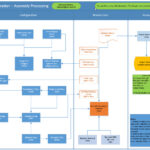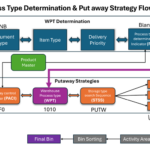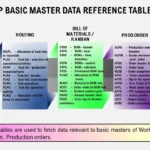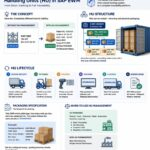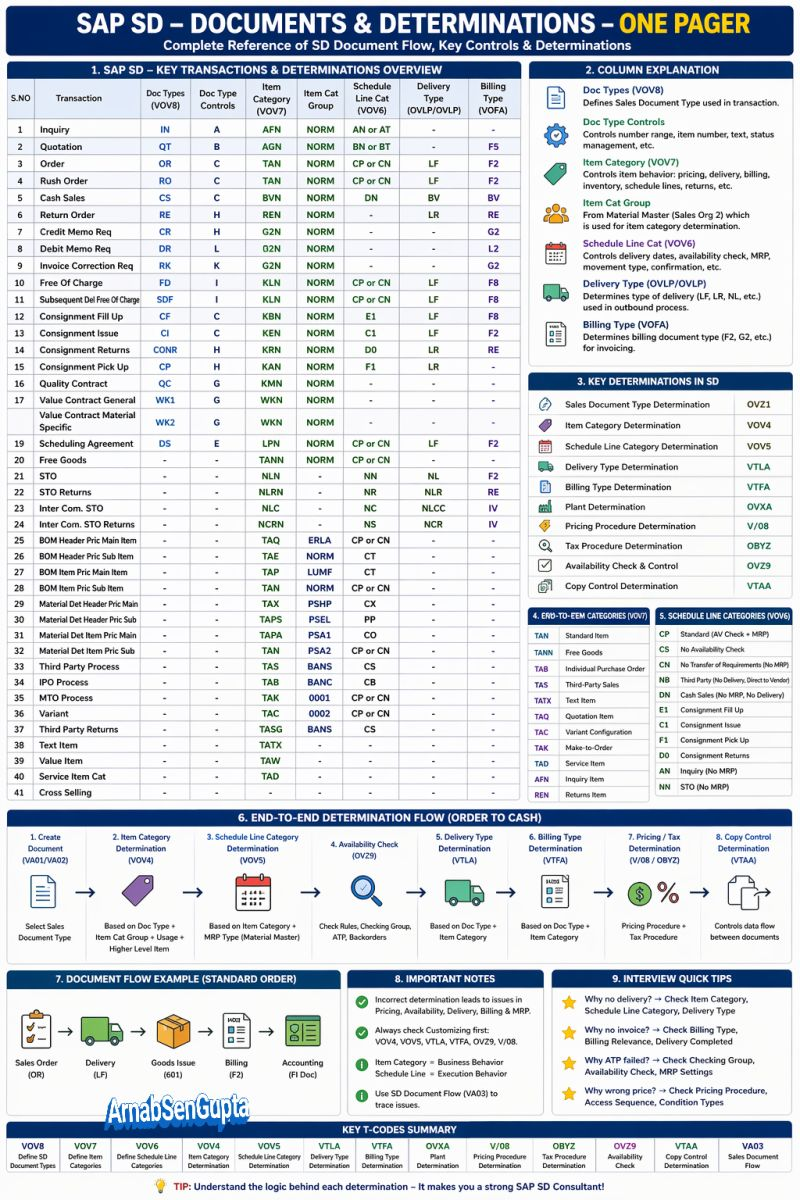
This visual presents a consolidated one-page overview of SAP SD documents and key determination logic used across the Order-to-Cash process. It brings together transaction types, document categories, item categories, schedule lines, and determination rules in a compact and process-oriented layout. The purpose of this cheat sheet is to help SAP SD users understand how sales documents are structured, how follow-on documents are created, and how the system determines critical behaviors such as pricing, delivery, billing, and account assignment.
From this visual, the reader can quickly see how SAP SD transactions are connected, which document types are used at each stage, and which determinations control system behavior during sales processing.
Cheat Sheet Description
The page is structured into clearly separated sections that explain SAP SD from a document and determination perspective. It combines tables, flow diagrams, and explanation boxes to provide both reference data and process logic in a single view.
The main areas covered are:
- SAP SD key transactions and document overview
- Document type and category explanations
- Key determinations used in SD
- End-to-end Order-to-Cash flow
- Standard document flow example
- Key tips and reminders for SD configuration and interviews
SAP SD Key Transactions Overview
The left section lists common SAP SD transactions across the sales cycle, starting from pre-sales and continuing through billing. Each transaction is mapped to:
- Sales document type
- Document category
- Item category usage
- Schedule line relevance
- Delivery type
- Billing type
This allows users to understand which technical objects are triggered when a specific SD transaction is created and how it impacts logistics and billing.
Document & Category Explanation
A dedicated explanation area describes the role of:
- Document types, which define the business purpose and allowed follow-on documents
- Document categories, which control system behavior such as delivery relevance or billing relevance
- Item categories, which determine whether an item is relevant for pricing, delivery, billing, or inventory movement
- Schedule lines, which control delivery quantities, availability check, and requirements transfer
This section helps clarify why similar-looking sales documents can behave differently in the system.
Key Determinations in SAP SD
The visual highlights the most important determination concepts used in SAP SD configuration, such as:
- Sales document type determination
- Item category determination
- Schedule line determination
- Delivery type determination
- Billing type determination
- Pricing procedure determination
- Account determination
Each determination is shown as a rule-based mechanism driven by master data, document attributes, and configuration tables.
End-to-End Order-to-Cash Flow
A simplified flow diagram illustrates the standard Order-to-Cash process from:
- Customer inquiry or quotation
- Sales order creation
- Delivery processing
- Goods issue
- Billing document creation
- Accounting posting
This flow helps visualize how SD integrates with logistics execution and financial accounting.
Document Flow Example
A sample document flow shows how a standard sales order progresses into delivery, goods issue, billing, and accounting documents. It emphasizes the system-generated links between documents and how SAP ensures traceability throughout the process.