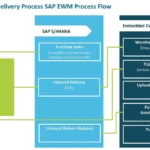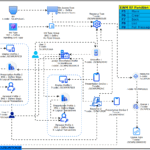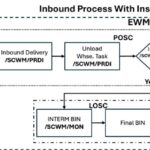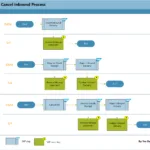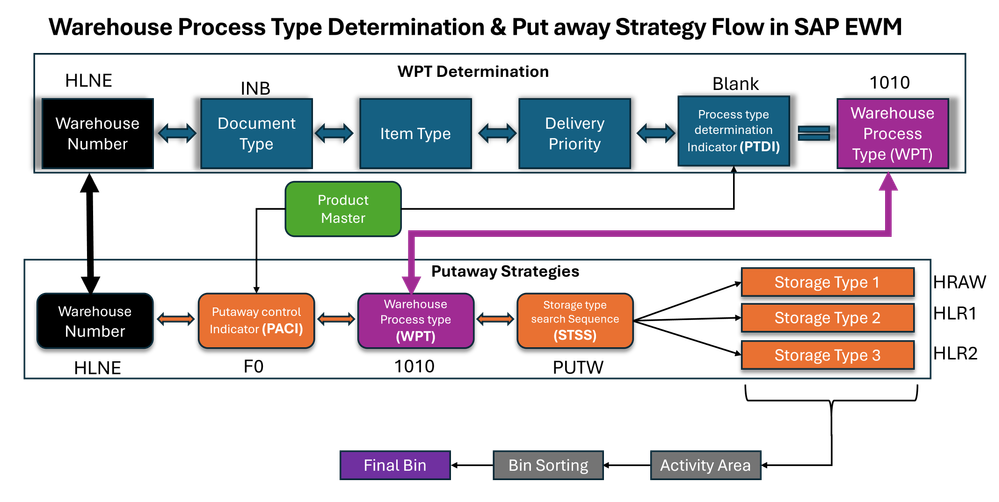
This visual illustrates how Warehouse Process Type (WPT) determination and putaway strategy work together in SAP Extended Warehouse Management. The diagram explains the end-to-end logic used by the system to decide how and where a product is put away in the warehouse after inbound processing. It connects document attributes, master data, and strategy settings to the final storage bin determination, helping readers understand the decision chain behind putaway execution.
The business purpose of this process is to ensure consistent, rule-based storage decisions in the warehouse by combining document data, product master settings, and warehouse customizing. From this diagram, the reader can understand which elements influence WPT determination and how putaway strategies guide the final bin selection.
Process Flow Description
The flow is split into two main areas:
- Warehouse Process Type Determination
- Putaway Strategy Execution
Both areas are connected through the Warehouse Process Type, which acts as the central control object.
1. Warehouse Process Type Determination
The upper part of the diagram shows how SAP EWM determines the Warehouse Process Type during inbound processing.
Key determination sequence:
- Warehouse Number
The process starts with the warehouse number, which defines the overall EWM organizational context. - Document Type
The inbound document type (for example, inbound delivery) influences the process classification. - Item Type
The item type further refines the process based on the type of warehouse task required. - Delivery Priority
Priority settings affect how urgently or critically the warehouse task should be processed. - Process Type Determination Indicator
This indicator controls whether and how the system performs WPT determination. - Warehouse Process Type (WPT)
Based on the above inputs, the system determines the WPT, which defines the operational behavior of warehouse tasks.
Product Master Influence
The product master is shown as an influencing element, providing additional attributes that can impact process determination and strategy selection.
2. Putaway Strategy Execution
The lower part of the diagram explains how the determined WPT is used to drive the putaway logic.
Key steps in the putaway area:
- Warehouse Number
The same warehouse context is used to ensure consistency in customizing. - Putaway Control Indicator (PACI)
The PACI defines which putaway strategy should be applied for the product and process. - Warehouse Process Type (WPT)
The WPT acts as a key link between process determination and physical storage behavior. - Storage Type Search Sequence
The search sequence defines the ordered list of storage types that the system checks during putaway. - Storage Types
Multiple storage types are evaluated in sequence until a suitable one is found. - Activity Area
Activity areas further restrict or guide bin selection based on operational zones. - Bin Sorting
Sorting rules determine the optimal bin within the selected storage type. - Final Bin
The process ends with the system determining the final destination storage bin for the product.
Diagram Highlights
- The Warehouse Process Type is the central control object connecting inbound processing and physical storage.
- Putaway behavior is not determined by a single setting but by a combination of document data, master data, and strategy configuration.
- Storage type search sequences allow flexible and prioritized storage decisions.
- The final bin is determined only after multiple layers of validation and sorting.
Key Takeaways
- Warehouse Process Type determination is rule-based and document-driven.
- Putaway strategies rely on PACI, WPT, and storage type search sequences.
- Product master data plays a supporting role in both determination and execution.
- The diagram provides a clear visual explanation of how SAP EWM ensures structured and predictable putaway behavior.
This process flow is especially useful for understanding how inbound logistics decisions translate into physical warehouse movements in SAP EWM.