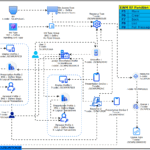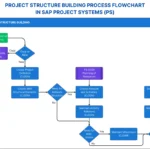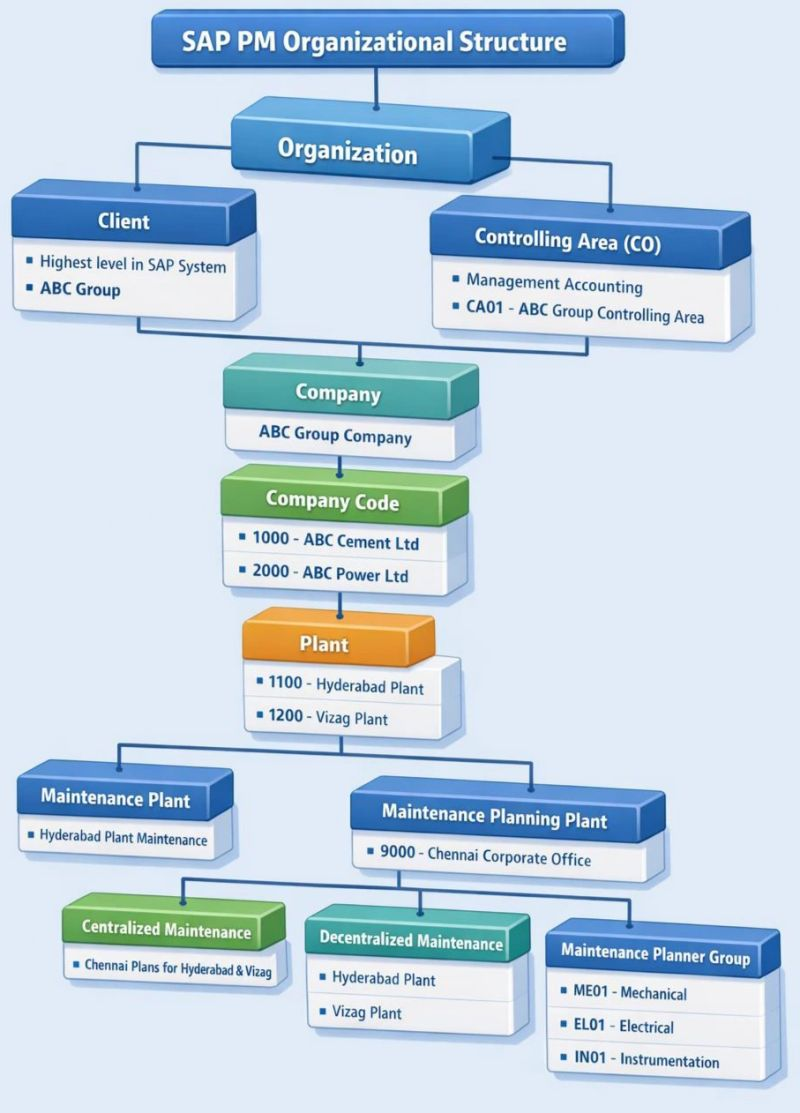
This visual illustrates the SAP Plant Maintenance (PM) organizational structure from the highest system level down to maintenance execution groups. It shows how organizational units are hierarchically connected and how maintenance responsibilities are distributed across the enterprise. The diagram helps explain how SAP PM is aligned with financial, controlling, and operational structures to support structured maintenance planning and execution.
By reading this diagram, you can understand how SAP PM fits into the overall SAP organizational model and how plants, maintenance units, and planner groups are logically linked.
Diagram Description
The diagram presents a top-down organizational hierarchy used in SAP PM, starting at the SAP system level and moving down to detailed maintenance execution units.
Key Elements in the Organizational Structure Diagram
Client
- Represents the highest level in the SAP system.
- Used to separate environments or corporate groups.
- Shown as the top-level container for all organizational units.
Controlling Area (CO)
- Used for management accounting and cost control.
- The diagram shows one controlling area assigned to the organizational structure.
- This level links maintenance costs to controlling and reporting.
Company
- Represents the corporate entity within the client.
- Acts as a grouping level for company codes.
Company Code
- Legal accounting entities used for financial reporting.
- The diagram shows multiple company codes under the same company.
- Each company code represents a separate legal entity.
Plant
- Operational locations where production or services take place.
- Plants are assigned to company codes.
- In the diagram, multiple plants exist under the same company code.
Maintenance Structure in SAP PM
Maintenance Plant
- Defines where maintenance work is executed and costs are collected.
- Each plant can act as a maintenance plant.
Maintenance Planning Plant
- Responsible for planning and scheduling maintenance activities.
- Can plan maintenance for one or multiple maintenance plants.
- In the diagram, a centralized planning plant is shown.
Maintenance Organization Models
- Centralized Maintenance
- Maintenance planning is done centrally for multiple plants.
- Improves standardization and planning efficiency.
- Decentralized Maintenance
- Each plant manages its own maintenance planning and execution.
- Provides flexibility for plant-specific requirements.
Maintenance Planner Group
- Represents teams or individuals responsible for planning maintenance work.
- Planner groups are typically specialized by discipline, such as mechanical, electrical, or instrumentation.
- This is the lowest level in the hierarchy and directly supports operational maintenance activities.