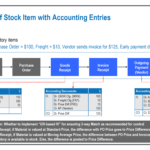
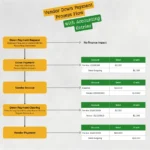
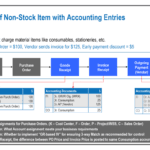
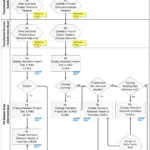
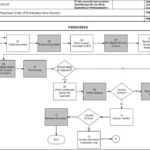
This flowchart explains how SAP price control affects accounting in the Procure-to-Pay (P2P) process, from Purchase Order creation through Goods Receipt (GR) and Invoice Receipt (IR). It compares Standard Price (S) with Moving Average Price (V) and focuses on how invoice price differences are handled in inventory and price difference accounts.
From Purchase Order to Goods Receipt
The process begins with Purchase Order creation and continues with Goods Receipt. At GR, the accounting entry depends primarily on whether the purchase is for stock or direct consumption.
For stock material, the flow shows a debit to Inventory (BSX), while consumable material is posted to Consumption (GBB). The offsetting entry is made to GR/IR Clearing (WRX).
The diagram then separates the subsequent accounting treatment according to the material’s price control:
- S – Standard Price
- V – Moving Average Price
The main difference becomes important when the supplier invoice contains a price variance.
Invoice Receipt with Standard Price Control
For materials using Standard Price (S), the stock continues to be valued at its predefined standard price.
At Invoice Receipt (MIRO), a difference between the relevant purchasing/valuation amount and the vendor invoice is therefore shown as a posting to the Price Difference account (PRD) rather than as an adjustment to inventory value.
The flow summarizes the result as:
- GR/IR is cleared.
- The vendor liability is recorded.
- The variance is posted to PRD.
- Existing stock value remains unchanged by that invoice variance.
This is the key accounting characteristic of the Standard Price branch in the diagram.
Invoice Receipt with Moving Average Price
For Moving Average Price (V), the diagram introduces an additional decision: how much stock is still available when the invoice is posted.
When sufficient stock remains, the illustrated variance can be absorbed into inventory, updating stock value and the moving average price.
If only part of the received quantity remains in stock, the diagram splits the difference between Inventory (BSX) and Price Difference (PRD). When no relevant stock remains, the variance is shown against PRD instead of inventory.
The important point is that Moving Average Price can therefore make the accounting treatment of an invoice variance dependent on the stock situation at the time of Invoice Receipt.
Account Keys Used in the Flow
The diagram uses four important SAP automatic account determination keys: BSX for inventory posting, WRX for GR/IR clearing, PRD for price differences, and GBB for consumption-related postings.
Key Takeaways
- Standard Price (S): invoice variances are directed to the price difference account while standard stock valuation remains unchanged.
- Moving Average Price (V): invoice variances may adjust inventory and the moving average price when stock is available.
- The amount of remaining stock becomes an important decision point for the Moving Average Price branch.
- GR/IR Clearing connects the Goods Receipt and Invoice Receipt accounting stages.
Editor Note: The debit/credit examples in the image represent a particular variance direction. If the invoice variance has the opposite sign, the corresponding posting direction can also reverse.