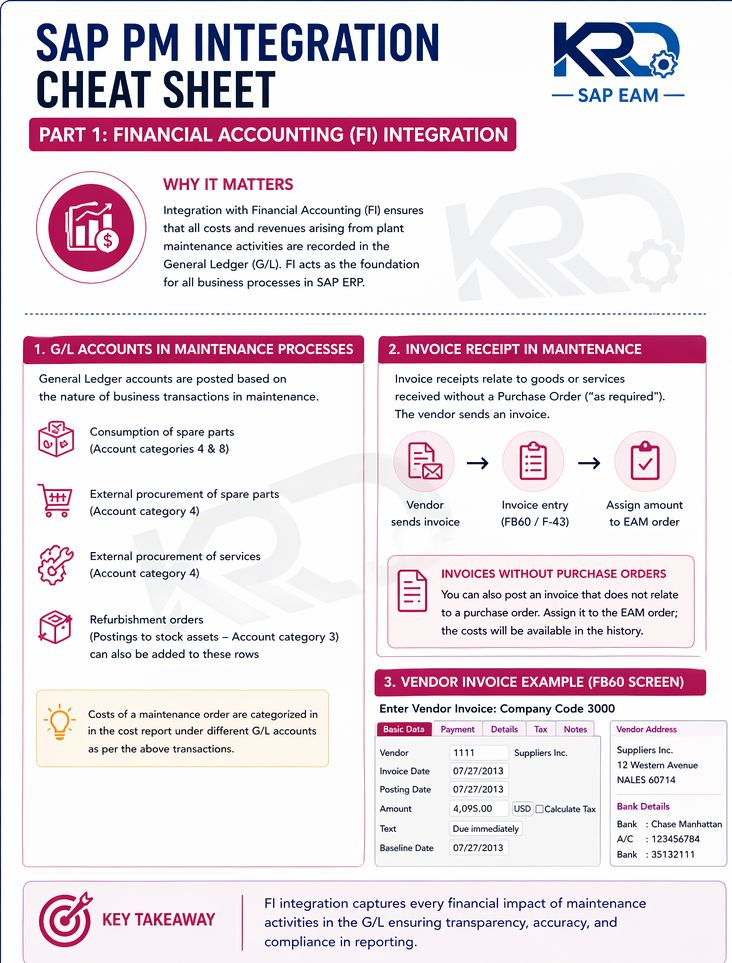
This visual cheat sheet explains how SAP Plant Maintenance (PM) integrates with Financial Accounting (FI) to ensure that all maintenance-related costs are correctly captured in the General Ledger. It provides a compact, process-oriented overview of why this integration matters, which cost categories are involved, and how vendor invoices are handled in maintenance scenarios. From this visual, the you can clearly understand how maintenance activities translate into financial postings in SAP ERP.
Cheat Sheet Description
The cheat sheet is structured into clear sections, focusing on the financial impact of maintenance processes. It highlights cost categories, invoice handling, and example financial postings related to SAP PM and FI integration.
Why PM–FI Integration Matters
The visual emphasizes that integration with Financial Accounting ensures that all costs and revenues arising from plant maintenance activities are recorded in the General Ledger. FI acts as the foundation for financial transparency, compliance, and reporting across SAP ERP.
G/L Accounts in Maintenance Processes
The cheat sheet groups maintenance-related costs by their accounting nature and corresponding G/L account categories:
- Consumption of spare parts
Costs posted when spare parts are used during maintenance activities. - External procurement of spare parts
Costs related to purchasing spare parts from vendors. - External procurement of services
Service costs incurred when maintenance work is outsourced. - Refurbishment orders
Costs posted to stock assets, typically related to repair or refurbishment scenarios.
It also notes that maintenance costs are categorized in the cost report under different G/L accounts depending on the transaction type.
Invoice Receipt in Maintenance
The visual outlines how vendor invoices are processed in maintenance scenarios:
- The vendor sends an invoice.
- The invoice is entered in the system.
- The amount is assigned to the relevant EAM or maintenance order.
This flow highlights the link between operational maintenance work and financial posting.
Invoices Without Purchase Orders
The cheat sheet also shows that invoices can be posted without a purchase order. In this case, the invoice is directly assigned to the EAM order, and the associated costs remain visible in the maintenance order history.
Vendor Invoice Example
An example vendor invoice screen is shown to illustrate typical header and item-level data, such as vendor details, invoice date, posting date, amount, currency, and bank information. This helps connect the conceptual process with an actual FI posting scenario.