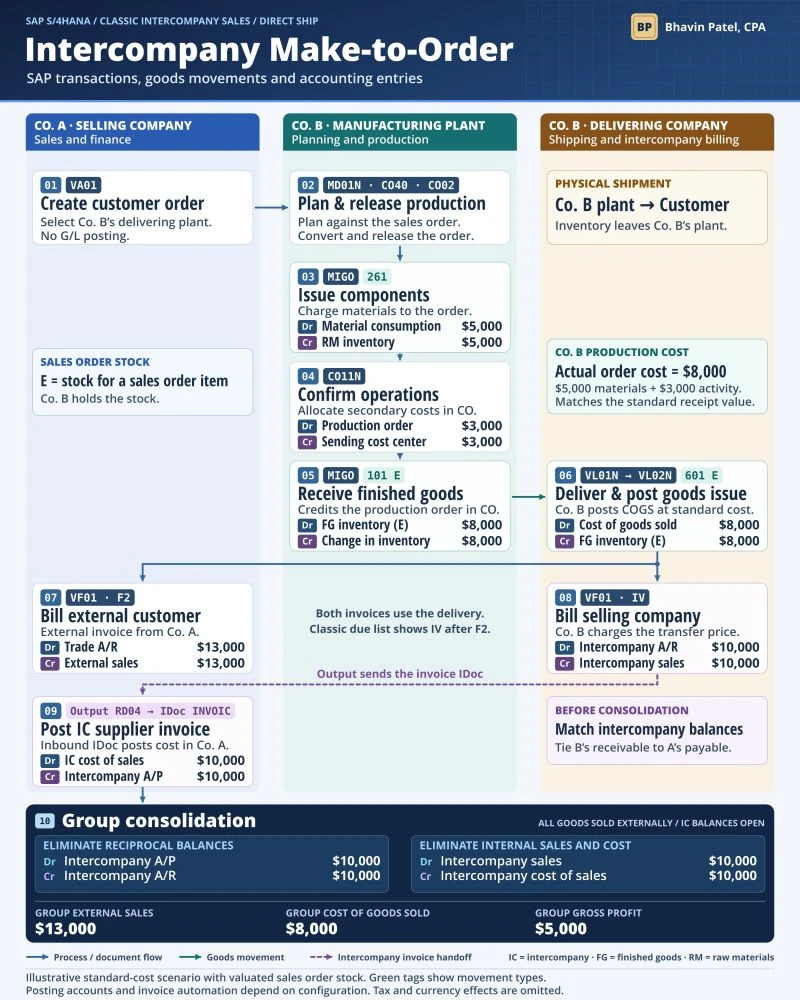
SAP intercompany make-to-order sales with direct shipment lets one company code sell to the customer while another company code produces and ships the goods. This walkthrough follows a classic intercompany sales scenario in SAP S/4HANA step by step, with the transaction, movement type and accounting entry at each stage, and ends with the group consolidation entries.
Intercompany Sales with Direct Ship: The Setup
Two company codes take part:
- Company A, the selling company, owns the customer relationship. It takes the sales order, invoices the external customer and receives an intercompany invoice from Company B.
- Company B, the manufacturing and delivering company, plans and produces the product in its plant, ships it directly to the customer and charges Company A a transfer price.
The finished product is made to order and held by Company B as valuated sales order stock (special stock E, stock for a sales order item). The figures are an illustrative standard-cost example: material $5,000, activity $3,000, transfer price $10,000 and external price $13,000. Posting accounts and invoice automation depend on configuration, and tax and currency effects are left out. The single-company version of this make-to-order flow is covered in SAP Make-to-Order with Valuated Sales Order Stock.
Sales Order in the Selling Company
Step 1: Create Customer Order (VA01)
Company A enters the customer order in VA01 and selects Company B’s plant as the delivering plant. This choice is what turns an ordinary sales order into an intercompany sale. The sales order has no G/L posting.
Production in the Manufacturing Plant (Company B)
Step 2: Plan and Release Production (MD01N, CO40, CO02)
MRP (MD01N) plans against the sales order. The planned order is converted into a production order (CO40) and released (CO02).
Step 3: Issue Components (MIGO 261)
Materials are charged to the production order: Dr Material consumption / Cr RM inventory ($5,000).
Step 4: Confirm Operations (CO11N)
The confirmation allocates secondary (activity) costs in CO: Dr Production order / Cr Sending cost center ($3,000).
Step 5: Receive Finished Goods (MIGO 101 E)
The finished product goes into sales order stock and the production order is credited in CO: Dr FG inventory (E) / Cr Change in inventory ($8,000).
In this example the actual order cost is exactly $8,000 ($5,000 materials + $3,000 activity), which matches the standard value of the goods receipt, so no production variance arises.
Shipment and Billing Between the Two Companies
Step 6: Deliver and Post Goods Issue (VL01N → VL02N, 601 E)
The goods physically leave Company B’s plant and go straight to the customer. Company B posts cost of goods sold at standard cost: Dr Cost of goods sold / Cr FG inventory (E) ($8,000).
The same delivery is the basis for two invoices. In the classic billing due list, the intercompany invoice (IV) appears after the customer invoice (F2) has been created.
Step 7: Bill the External Customer (VF01, F2)
Company A invoices the customer: Dr Trade A/R / Cr External sales ($13,000).
Step 8: Bill the Selling Company (VF01, IV)
Company B charges Company A the transfer price: Dr Intercompany A/R / Cr Intercompany sales ($10,000).
Step 9: Post the Intercompany Supplier Invoice (Output RD04 → IDoc INVOIC)
The output on the intercompany invoice sends an INVOIC IDoc, and the inbound IDoc posts the cost in Company A automatically: Dr IC cost of sales / Cr Intercompany A/P ($10,000).
Before consolidation, the intercompany balances are matched: Company B’s receivable must tie to Company A’s payable.
Group Consolidation of the Intercompany Sale
Once all goods have been sold externally and the intercompany balances are still open, step 10 removes the internal transaction from the group view with two eliminations:
| Elimination | Debit | Credit | Amount |
|---|---|---|---|
| Reciprocal balances | Intercompany A/P | Intercompany A/R | $10,000 |
| Internal sales and cost | Intercompany sales | Intercompany cost of sales | $10,000 |
What remains for the group is the external view: external sales $13,000, cost of goods sold $8,000 and gross profit $5,000. Company B’s $2,000 margin and Company A’s $3,000 margin add up to the same $5,000 group gross profit. Period-end closing steps that come before consolidation are covered in GL Month End Closing Process Flowchart (Part 3/3).
Intercompany Make-to-Order T-Codes and Postings
| Step | Company | T-code / document | Dr / Cr | Amount |
|---|---|---|---|---|
| 1 Create customer order | A | VA01 | No G/L posting | — |
| 2 Plan & release production | B | MD01N, CO40, CO02 | — | — |
| 3 Issue components | B | MIGO 261 | Material consumption / RM inventory | $5,000 |
| 4 Confirm operations | B | CO11N | Production order / Sending cost center | $3,000 |
| 5 Receive finished goods | B | MIGO 101 E | FG inventory (E) / Change in inventory | $8,000 |
| 6 Deliver & post goods issue | B | VL01N → VL02N, 601 E | Cost of goods sold / FG inventory (E) | $8,000 |
| 7 Bill external customer | A | VF01, F2 | Trade A/R / External sales | $13,000 |
| 8 Bill selling company | B | VF01, IV | Intercompany A/R / Intercompany sales | $10,000 |
| 9 Post IC supplier invoice | A | Output RD04 → IDoc INVOIC | IC cost of sales / Intercompany A/P | $10,000 |
| 10 Consolidation | Group | — | IC A/P / IC A/R; IC sales / IC cost of sales | $10,000 each |
Additional SAP Notes (Not Shown in the Diagram)
These points are general SAP knowledge added for context, not part of the original image:
- F2 is the standard customer invoice billing type and IV is the standard intercompany billing type.
- For intercompany billing, the selling company’s sales organization is represented by an internal customer number in the delivering company, so the IV invoice has a customer to bill.
- Movement type 601 is the goods issue for a delivery; with special stock E it is posted from sales order stock.
Key Takeaways
- The selling company (A) owns the customer and the external invoice; the delivering company (B) produces, ships and bills A at the transfer price.
- Company B’s actual production cost of $8,000 matches the standard, so COGS at goods issue equals the production cost.
- One delivery drives two invoices: F2 to the customer and IV to the selling company.
- The INVOIC IDoc posts the intercompany supplier invoice in Company A automatically.
- Consolidation eliminates the $10,000 intercompany balances and internal sales, leaving $13,000 sales, $8,000 COGS and $5,000 gross profit.
For the stock transport order route between company codes, see Inter Company STO Process Flow in SAP.
Diagram as Text
Show the diagram as plain text
Co. A · Selling company (sales and finance): 01 VA01 Create customer order (select Co. B’s delivering plant; no G/L posting). Sales order stock: E = stock for a sales order item; Co. B holds the stock. 07 VF01 · F2 Bill external customer (external invoice from Co. A; Dr Trade A/R $13,000, Cr External sales $13,000). 09 Output RD04 → IDoc INVOIC, Post IC supplier invoice (inbound IDoc posts cost in Co. A; Dr IC cost of sales $10,000, Cr Intercompany A/P $10,000).
Co. B · Manufacturing plant (planning and production): 02 MD01N · CO40 · CO02 Plan & release production (plan against the sales order; convert and release the order). 03 MIGO 261 Issue components (Dr Material consumption $5,000, Cr RM inventory $5,000). 04 CO11N Confirm operations (allocate secondary costs in CO; Dr Production order $3,000, Cr Sending cost center $3,000). 05 MIGO 101 E Receive finished goods (credits the production order in CO; Dr FG inventory (E) $8,000, Cr Change in inventory $8,000). Both invoices use the delivery; classic due list shows IV after F2.
Co. B · Delivering company (shipping and intercompany billing): Physical shipment Co. B plant → Customer (inventory leaves Co. B’s plant). Co. B production cost: actual order cost $8,000 ($5,000 materials + $3,000 activity), matches the standard receipt value. 06 VL01N → VL02N 601 E Deliver & post goods issue (Co. B posts COGS at standard cost; Dr Cost of goods sold $8,000, Cr FG inventory (E) $8,000). 08 VF01 · IV Bill selling company (Co. B charges the transfer price; Dr Intercompany A/R $10,000, Cr Intercompany sales $10,000); output sends the invoice IDoc to Co. A. Before consolidation: match intercompany balances (tie B’s receivable to A’s payable).
10 Group consolidation (all goods sold externally / IC balances open): eliminate reciprocal balances (Dr Intercompany A/P $10,000, Cr Intercompany A/R $10,000); eliminate internal sales and cost (Dr Intercompany sales $10,000, Cr Intercompany cost of sales $10,000). Group external sales $13,000; group cost of goods sold $8,000; group gross profit $5,000.
Notes: IC = intercompany, FG = finished goods, RM = raw materials. Illustrative standard-cost scenario with valuated sales order stock. Posting accounts and invoice automation depend on configuration. Tax and currency effects are omitted.